Wednesday, May 20, 2015

Hass and Associates Accounting: Fake buyout bid underscores lax system

A fake takeover bid for Avon was filed with the SEC, causing a stir in the market and a sharp rise in Avon's shares. At the same time, it highlights the possibility that the filing system used by Wall Street is not that secure after all.

Thirty minutes before noon last Thursday, a regulatory filing appeared on the website of Securities and Exchange Commission detailing an offer from one PTG Capital Partners to buy Avon for USD 18.75 per share.

The filing caused such a stir that within several minutes, news wire services have reported on it. But when the dust settled down after noon, it turned out that the information stated in the regulatory filing is not accurate, leading some to conclude that it might be a hoax. The supposed British company and its legal representative in the US cannot be reached as well.

Avon has been rumored to be sold for some years now so this surprising filing is not entirely out of the blue. But when Avon finally stated its side, it was to deny that a buyout offer has been made for them.

Eventually, it proved to be a fake buyout bid. Throughout the day though, USD 91 million worth of stocks from Avon has been bought/sold and its stock price increased by almost USD 1.

Now, SEC officials have yet to confirm who made the fraudulent filing and if there was a clear intent at market manipulation. At any rate, concerns about the integrity of the Edgar database -- a system used by companies and financial managers who are involved in public trading to make filings -- are rising.

Apparently, companies make routine filings to the Edgar database -- totaling around 4000 filings every day -- all of which is made public at once. This is why it took some time to verify the offer. Moreover, in a bid to encourage companies to have consistent disclosure, third party filing is allowed in the Edgar system. This means that any insider, stockholder or fraudster could file to Hass and Associates Accounting's cache, for instance, even without credentials to officially file on its behalf.

It is unclear exactly how the agency verifies the filed information. According to SEC, "Under the federal securities laws, filers are responsible for the truthfulness of their filings, and they are subject to enforcement actions when they are false or misleading."

What's more, this does not seem to be the first time that Edgar database has been misused: In 2012, a false bid to buy Rocky Mountain Chocolate Factory was made by a supposed British firm called PST Capital Partners through the Edgar system.

Hass and Associates Accounting noted that an important takeaway from this incident could be the breaking of the belief that being in Edgar is equivalent to a stamp of approval from the SEC.

Tuesday, May 5, 2015

Tips to avoid tax fraud

Reports say tax fraud victims have lost around US$15 million to cybercriminals since 2013.

Fraudsters may come in many forms:

- They can pretend to be an Internal Revenue Service (IRS) agent, who tricked their victims into paying thousands of dollars each through phone calls. Call recipients were threatened to pay up or get charged.

- Some often used malware such as Trojan spyware, banking Trojans or remote access tools (RTAs) to gain access to potential victims’ computers or bank accounts.

- And the brazen ones present themselves as IRS agents and show up in your front door.

Over the years, the attackers’ means may have evolved but their goal remains the same, and that is to deceive victims into giving out their personal information, including Social Security numbers, banking information and other private details.

Tax-related identity theft occurs when attackers uses your stolen Social Security number to file a fraudulent tax return early in the year. You may be unaware that you are already a victim until you try to file your taxes and discover that a return has been filed using your number.

Professionals from Hass and Associates Accounting advise people to keep and protect their Social Security number and other financial information, provide it only when it’s required. Don’t just hand it over because someone asks for it.

Given in the following are examples of tax fraud with tips on how to avoid them.

1. Phone fraud

One example of a phone fraud goes something like this: Someone claims to an IRS agent calls you with bad news. He/she will say that you owe the government unpaid tax money and if you don’t pay immediately over the phone with a credit or debit card; you’ll be audited, arrested or even deported.

If you receive that kind of phone call then it’s a big lie. IRS media spokesperson, Patricia Svarnas said that’s not how IRS does business. They would never ask for your debit or credit card number, and they don’t threaten you with audits, jail time, or deportation.

2. Phishing

Phishing is the fraudulent practice of sending emails claiming to be from reputable agencies or companies like IRS in order to induce individuals to reveal personal information, such as passwords, credit card numbers, and Social Security number, online.

These emails often include a link to a website that looks very similar to an official IRS site. You should not open attachments or click on clicks contained in these messages.

Svarnas said that never respond anything you receive through email. IRS does not initiate contact with taxpayers by email requesting their personal or financial information, including any kind of electronic communication, such as text messages.

3. Tax preparer fraud

Some fraudulent tax preparer who claims to be a tax professional will ask taxpayers to have their refund deposited into the preparer’s checking account.

The IRS advises taxpayers to be very careful when choosing a tax preparer, not someone who recently jumped into the tax filling business to make fast money. If a tax preparer is not associated with a nonprofit or commercial service, make sure they are approved by the IRS.

Monday, March 30, 2015

Hass and Associates Accounting: Cyanogen Ready to take on Google's Android

The mobile OS-maker Cyanogen has just raised USD 80 million in its Series C funding round with backing from Twitter, Rupert Murdoch and Qualcomm, making its goal of taking Android from Google all the more possible.

The people behind Cyanogen have consistently expressed their vision to make Android a more "open" ecosystem and OS. "We're committed to creating an open computing platform that fundamentally empowers the entire mobile ecosystem from developers to hardware makers, and most importantly, consumers around the world. We're excited to have the backing of an amazingly diverse group of strategic investors who are supporting us in building a truly open Android," said Kirt McMaster, Cyanogen's CEO.

Other notable investors in the most recent round include Telefonica, Access Industries, Smartfren Telecom, Vivi Nevo and Index Ventures. In Cyanogen's previous funding rounds, they got USD 30 million from Tencent, Redpoint Ventures, Benchmark and Andreessen Horowitz. This particular round which left the startup with a total of USD 110 million was led by India's Azim Premji PremjiInvest, as reported by Hass and Associates Accounting.

Horowitz's partner, Peter Levine, who invested in the second round of funding said, "App and chip vendors are very worried about Google controlling the entire experience." He also admitted that at first he did not think "a startup could come in and create a new OS".

A number of other tech giants have already tried to crack a shot at the mobile OS market such as Samsung, Microsoft, Nokia, Blackberry, Intel, Palm and Mozilla. McMaster admitted he's well aware of the big risk and that's precisely why he thinks using Android is the only way to effectively take on Google. By making available to the public the code of Cyanogen, he's expecting to gain support from app developers who wants to have another option aside from the limited ones currently provided by Google and Apple. For instance, a payment solutions provider could create a highly customized payment system that can work better than Apple Pay or Google Wallet.

Sandesh Patnam of Premji Invest said, "We invested in Cyanogen because we're big proponents of what they're doing in opening up Android and supporting global and local ecosystem players. Cyanogen is well-positioned to become the third leading mobile OS, and we're excited to back them in growing their business on a global scale."

Formed 6 years ago as CyanogenMod Project, it started with 40-year old programmer Steve Kondik tinkering with Android code to maximize its performance. Soon enough, online forums have started to pick up on his customizable version which led to other programmers joining him. Hass and Associates Accounting's report says that as early as 2011, a million mobile phones have Cyanogen installed in it.

To date, around 50 million handsets are running Cyanogen, most of those underwent flashing and rebooting. Considering that one has to take time and effort in erasing the current OS of the phone before installing Cyanogen, it's not a stretch to say that there is indeed a demand for a highly-customizable OS.

Monday, March 9, 2015

Hass and Associates Accounting Hong Kong Tax News and Tips: 5 Tips to Avoid ID Theft and Refund Fraud During Tax Season


Your Social Security Number could be the ticket for a fraudster seeking to claim a false tax refund or worse, according to the Internal Revenue Service (IRS). A fraud expert offers some tips for preventing such crime – or at least catching it early.

Bruce Dorris, J.D., CFE, CPA, CVA, is vice president and program director for the Austin, Texas-based Association of Certified Fraud Examiners (ACFE). With nearly 75,000 members, the ACFE is the world’s largest anti-fraud organization and premier provider of anti-fraud training and education. Dorris offered the following tips for staying ahead of would-be identity thieves during tax season:

1. File as soon as possible. When it comes to filing taxes, those who put it off until the last minute face greater risk. “Fraudsters may try to claim a refund using your identity before you have a chance to submit a legitimate claim,” Dorris said. “By filing early, you can beat them to the punch – at least this year.”

2. Don’t trust that phone call or email. A common scam involves a fraudster contacting the victim, claiming to be from the IRS and asserting that the taxpayer owes money and must pay immediately. They ask for bank account, credit card or other financial information. “This isn’t the way the IRS operates, and no one should provide such information over the phone or via email,” Dorris said.

3. Check your credit history. Free credit reports are available at annualcreditreport.com. Information in your report can indicate whether a tax fraudster has used your identity for nefarious purposes beyond just refund fraud. “Reviewing your credit report will tip you off if anyone has been opening lines of credit in your name,” Dorris said. “Make sure all of your information is accurate and includes only those accounts and transactions you have authorized.

4. Report anything suspicious. Emails purporting to be from the IRS, strange phone calls, odd things on your credit report – any of these can be telltale signs of attempted fraud. Also, “if you receive a notice from the IRS that you filed more than one tax return or someone has already filed using your information, that’s a big red flag,” Dorris said. “If you are informed that you have a mysterious balance due or that you received wages from an employer you have not worked for, it’s time to contact the IRS.” Call their Identity Protection Specialized Unit at 1-800-908-4490.

5. If you’ve been a victim, create an Identity Theft Report. According to the Federal Trade Commission (FTC), an Identity Theft Report will help you deal with credit reporting companies, debt collectors and businesses that gave the identity thief credit or opened new accounts in your name. “If you have been the victim of identity theft, having a record on file will help you repair the damage to your credit report and deal with any creditors who are attempting to collect on fraudulent charges,” Dorris said. “It will also place an extended fraud alert on your credit report, which can help prevent further fraudulent activity moving forward.”

More tips? Hass Associates Accounting may help you. Hass Associates Accounting was at first doing business as the Tax Center and was then evolved to an accounting industry concerning about income tax preparation. Years thought us many things, introduced us many people and their walks of life.

Thursday, March 5, 2015

Tax Fraud: How Not To Become A Victim This Filing Season by Hass and Associates Accounting Hong Kong Tax News and Tips

The Internal Revenue Service has issued a lot of warnings about tax-related fraud. It’s on the rise, and it can be a real pain if you’re a victim.

If you haven’t filed yet, this is not the year to procrastinate. As I reported this week, the IRS said that threatening and aggressive phone calls by someone impersonating an IRS agent take the top spot in its annual list of “Dirty Dozen” tax scams.

The Federal Trade Commission said it received 109,063 complaints last year about tax-identity theft. It received 54,690 complaints about IRS imposter scams, up substantially from the 2,545 scams reported in 2013.

So what should you do if you try to file your tax return and realize someone else — a crook — has beat you to it and received a refund based on fraudulent return? The Washington Post’s Jonnelle Marte provides a road map to help if you’ve been a victim of tax fraud.

One of the first things you should do is report it, Marte says. “Fake tax returns need to be reported directly to the identity protection division of the IRS. Victims need to fill out an Identity Theft Affidavit to create an alert on their account,” she writes.

You should also check your credit reports. If someone has enough information to file a fake return, they have enough to cause other damage to your credit history.

Color of Money Question of the Week

What drives you nuts about tax season? Send your comments to colorofmoney@washpost.com. Put “Taxing Season” in the subject line.

New to you this tax season

Looking for a nice roundup of tax issues you need to know about? Then check out the New York Times’s Jan M. Rosen’s tips for navigating the 2015 tax season.

“What’s new this tax season? In a word: Obamacare. That’s the answer given by many tax professionals,” writes Rosen, who provides tips on deductions for job hunting, state sales tax and medical expenses.

If you’ve got a question about your refund, check out these most frequently asked questions posted by the IRS.

And Jim T. Miller, writing for the Huffington Post, provides a rundown of the IRS filing requirements for this tax season.

Tax challenges for gay couples

It’s a challenging tax season for some married gay couples.

“This tax season is particularly bitter for gays and lesbians who live in states that still don’t recognize same-sex marriage,” writes Ben Steverman for Bloomberg. “After decades together, many are filing their first joint tax returns. In a growing number of states, this is easy: An additional 20 states have legalized same-sex marriage since the beginning of 2014. But in Georgia, Michigan, Ohio, and nine other states, gay couples are still treated as legal strangers. They face extra paperwork, heftier tax-prep fees, and tax questions that puzzle even the experts.”

Steverman profiles one couple who have to file five tax returns. “First, they complete a joint, official federal return that they’ll file with the IRS,” he writes. “Then, they must each fill out — but not file — a federal return as if they were single people, shadow returns they’ll use to prepare their state tax returns.”

Live chat today

Let’s talk. Last week, we discussed love and money. This week, it’s an open forum. So what’s on your mind where your money is concerned?

Join me at noon ET for a live, online discussion about your finances.

Tuesday, March 3, 2015

Hass and Associates Accounting Hong Kong Tax News and Tips: Keeping Online Tax Returns Safe From Thieves


After several states suspended e-filing through the popular online tax preparer, TurboTax itself temporarily pulled the plug on its state tax return e-filing services last week due to security concerns.

The company, owned by Intuit, which also owns QuickBooks, Mint, Quicken and a variety of other personal finance and small business accounting products, resumed all regular services the following day. (Disclosure: The author owns a small amount of stock in Intuit.)

Julie Miller, a spokeswoman for Intuit, says TurboTax has implemented a series of enhanced security measures, which includes multistep authentication, similar to the protections used by banks and financial institutions. All state tax departments have resumed accepting returns filed through TurboTax, Miller says.

Although the interruption sent shock waves through the industry, as many suspected a cyber breach, TurboTax later said that the company’s system had not been compromised. Instead, scammers had stolen personally identifiable information elsewhere, and used it to file fraudulent returns. "We want to assure our customers and taxpayers generally that TurboTax is safe and secure, and we’ve taken every necessary and appropriate action to safeguard customers’ information," Miller says.
Despite the assurances, TurboTax's troubles confirmed what fraud experts had been saying for years, that filers should be aware that tax returns are prime ground for hucksters and thieves.

Ease of Filing = Ease of Theft

For many Americans, late winter and early spring are just the beginning of the tax preparation process of receiving 1099 and W-2s, gathering receipts, contacting accountants or choosing an online tax preparer. But identity theft expert Steve Weisman, author of “Identity Theft Alert: 10 Rules You Must Follow to Protect Yourself from America's #1 Crime” and “50 Ways to Protect Your Identity in the Digital Age,” says many tax identity thieves act on the first day of filing on Jan. 20, when taxpayers are most vulnerable.

"We know the issue: that anyone can steal a Social Security number, file electronically, and all the things that are being done by the IRS and Congress to make things easy for taxpayers are making it even easier for the fraudsters," Weisman says.
And it's not just the IRS and Congress. Many companies strive to ease the burden of filing, and that convenience can come with a price. Taxpayers who file their taxes via mobile, tablets and apps, sometimes on shared wireless networks, need to be especially diligent about their security.

"One of the primary factors of tax identity theft and fraud is that you can e-file behind a computer screen, which is really convenient if you're going to do something illegal," says Matt Davis, a spokesman for the Identity Theft Resource Center. "If you're a victim of tax identity theft, you're most likely going to be a victim of the other kinds."


Both Weisman and Davis say that, aside from protecting personal information and Social Security numbers year-round, the single most important step in preventing tax-related identity theft is to file a tax return as early as possible.

"The IRS doesn't independently verify tax returns. They only know there's a problem once they've received a second return under the same Social Security number," Davis says. "If you're the first one in the door, you're going to have your taxes filed correctly. "

Weisman says that once a fraudulent tax return is filed, gaining access to an ill-gotten refund is fairly easy. "Identity thieves are able to file electronically, the refunds are sent either to a bank electronically or via a prepaid debit or credit card, or sent the old way with a check, which can then be fraudulently cashed," he says.

In addition to filing early, the Federal Trade Commission offers these tips to prevent identity theft:

•          Use a secure Internet connection if you file electronically, or mail your tax return directly from the post office.
•          Shred copies of your tax return, drafts or calculation sheets you no longer need.
•          Respond to all mail from the IRS as soon as possible.
•          Don’t give out your Social Security number unless necessary.
•          Research a tax preparer thoroughly before you hand over personal information.
•          Check your credit report at least once a year for free at annualcreditreport.com to make sure no other accounts have been opened in your name.
•          And this important reminder: The IRS does not ever contact taxpayers by email, text or social media, only via regular mail. Any other forms of contact are fraudulent and should be reported.

If Your Information Has Been Compromised

Once a Social Security number has been compromised for tax fraud, it's extremely likely that it will be used for other types of fraud, including credit card and medical. People who have been victims of tax identity theft should take a sweeping response to the theft by notifying their banks, credit card companies, credit reporting agencies and the proper local and federal authorities. Weisman recommends voluntarily freezing credit reports to prevent new, fraudulent accounts from being opened with a stolen Social Security number. Such freezes can be easily removed and replaced for legitimate purposes.

"If you've been a victim of tax fraud, you need to check your credit reports. It's also a good idea to get a pre-emptive police report, and put alerts on all your accounts," Davis says. "Notifying law enforcement at the outset goes a long way to establishing your credibility with anyone you're going to have dispute the fallout of the fraud with."

The good news is there is no shortage of helpful information for tax filers. The FTC offers tips for preventing tax identity theft on its website, as does Weisman's blog, Scamicide.

Taxpayers who suspect they've been victims of identity fraud should call the IRS Identity Theft Protection Specialized Unit at 1-800-908-4490 with a copy of a police report, the completed IRS affidavit (Form 14039), and state-issued identification. More information can be found in the Taxpayer Guide to Identity Theft on the IRS website.


Tuesday, June 10, 2014

Hass Associates Accounting Financial fraud in 25 years: A virtual Madoff at lightning speed

From the very moment that people started using money, perhaps, some have uncovered ways of stealing it. And so, as sure as there will still be money after 25 years — or in some other form — corporate fraudsters will still be plying their trade. But innovative technologies could produce an environment where, as one retired law-enforcement official warns, “There will be no boundaries in relation to what fraud can be perpetrated.”

Crime investigators state that the crimes per se do not completely change. From our common frauds and Ponzi schemes to intricate security breaches, tax avoidance and money laundering, there are still various ways a criminal can make a dirty buck. When CNBC began in 1989, junk bond king Michael Milken was being accused of securities fraud charges in a sensational investigation. After 25 years, a new Wall Street insider-trading investigation — this time centering on hedge funds — has victimized 79 people, perhaps, more.

Imagine a world where an inside-trader can obtain his information not from an insider who works in a firm but from a hacker working outside and stealing data from the organization’s data systems in the cloud. He shares the data to others through a bunch of intricately encrypted, untraceable instant messages. The unlawful act is done in nanoseconds. The money is disbursed through virtual currency. And the criminals thrive happily plying their trade and stealing from other victims any new day.

And imagine a Ponzi schemer — a future-generation Bernie Madoff – except that he is not human at all but a poser for a rogue nation with the ability to rob you, spend your money and stash it away in a split second.

Enter the world of white-collar crime, 2039.

“Simply use your imagination as to the form of fraud you wish to perpetrate,” said Thomas G.A. Brown, who assisted in launching cyber investigations in the U.S. Attorney’s Complex Frauds Unit in Manhattan.

Brown, presently a senior managing director at FTI Consulting, said the future white-collar criminal will be quicker and more highly invisible than before — allowing the possibility for “nearly the perfect crime.”

In truth, cybercriminals can already perform some of those heists today.

“Crime in cyberspace is not merely the coming trend of the future; it is here with us now,” said E. Danya Perry, also a former senior deputy in the Manhattan U.S. Attorney’s office, now practicing privately. “I believe we will be seeing more of how this chameleon will evolve into a raging dragon.”

Cyberspace crimes already cost the U.S. economy about $120 billion yearly and the entire globe about $1 trillion, as revealed by a study published in 2013 by McAfee and the Center for Strategic and International Studies. And all that in a crime onslaught that is comparatively only new.

Prosecutors obtained a view of what the future will look like from last year’s taking down of Silk Road — a clandestine website which officials authorities claimed was “the most advanced and widespread illegal marketplace online.”

Although Silk Road specialized on the lucrative prohibited drug trafficking, Brown of FTI Consulting reported that agents uncovered methods that could “skyrocket financial crime’s spread.”

Virtual stash

The primary technique among several promising tools is the new virtual currency called bitcoin, which is already changing the face of the global payment structure.

“Bitcoin is so hard to manage,” Brown said.

In the Silk Road case, which Brown built with others, the federal government has captured an amount of over $33 million bitcoin money from the computers of the site’s accused founder, Ross William Ulbricht. However, that amount is a small part the $1.2 billion in sales the system allegedly generated within less than three years of operation. And detecting where the rest of the money is located is almost impossible.

“Imagine every bitcoin as being a gold bar,” Brown said. No one knows where that gold bar originated, and anyone can readily sell it for cash. “Anyone can steal it and run away with it.”

Even if agents can locate bitcoin in a certain account, that clue will not mean the owner can be traced. “No one is required to register a bitcoin account in a genuine name,” Brown said.

There exist other virtual currencies aside from Bitcoin. Back in 2013 as well, a federal grand jury in New York charged Liberty Reserve for trafficking in the currency referred to as LR. Officials captured five Internet domains and charged 35 currency-trading websites in what was billed by Manhattan U.S. Attorney Preet Bharara as one of the biggest global money-laundering cases in legal history.

The implications of the virtual money revolution on white-collar crime are vast. At the bottom, Brown said, the virtual cash could make tax avoidance become easier than before.

“I can enter into any kind of deal I want to derive income without paying taxes since no one is aware of what I’m doing,” Brown said.

“The financial rewards are going to be very compelling for any person to want to trespass the law ,” Perry said.

Exactly how regulators and law enforcers will clamp down on those tempting baits — and what government agencies will head the move — remains unresolved.

In March, the Internal Revenue Service released its first advisory on virtual currencies such as LR and bitcoin.

“Virtual money is considered as property for U.S. federal tax purposes,” the IRS stated in a March 25 announcement. “A disbursement with virtual cash is covered by information reporting within the same limitations imposed upon any other disbursement made in property,” the announcement stated.

Yet, in our world where financial crimes are perpetrated by faceless people, where do we point an accusing finger?

Fraudsters anonymous

“Locating people in an environment of uncertain identities is a difficult task,” said Perry. “When you have a place where you can make deals incognito, this sort of problem will keep going.”

In the Silk Road investigation, officials say numerous drug dealers and over 100,000 of their customers covered their identities by utilizing what are called tumblers, which jumbled their personal identity information to produce anonymous transactions.

Cybercriminals now also often use a technology called Tor — formerly the acronym for The Onion Router, for its multi-layered complexity — to hide their online tracks.

Tor software, which is free online, lets the user to hide his PC’s IP address — its virtual fingerprint — as well as every server’s IP address to which the PC connects.

“Imagine a gigantic pinball machine,” Brown said, where your PC is the silver ball bouncing around. Each time the ball touches a bumper, its identity — or IP address — changes and so with the bumper, making it “functionally impossible” to trace the traffic.

Aside from making illegal deals and underground websites invisible, Tor provides criminals —whether the financial kind or otherwise — a means to interact and pass on data more easily than before.

“Traditionally, you have to identify ‘Harry from Bensonhurst’ or ‘Johnny from the block’ to round up a robbery group,” Brown said.

Today, with their virtual masks covering their faces using all the new technology, white-collar criminals, hackers and identity robbers can assemble and exchange information without fear in so-called carding venues. For such bandits, chat rooms are not merely for socializing. They are sources of stolen identities, software code and even cash beyond the scope of authorities.

“A savvy crook utilizing effective functional security is almost impossible to locate,” said Brown.

Falling prey to the schemes of tomorrow’s crook, he said, are firms that are already forced to share more and more of their valuable information in the web and in the cloud so their workers and clients can readily get that information — a signal for hackers to prowl for victims.

“Many firms concentrate on merely the collecting and using of the information instead of securing that information,” Brown clarified.

Fighting back

The future white-collar cybercriminal may not be a single person. It could actually be a whole country. Brown is apprehensive of the coming “nation-state” in financial crime. “Much of this is not talked about extensively, if at all, due to its confidential nature,” he said.

Friday, May 23, 2014

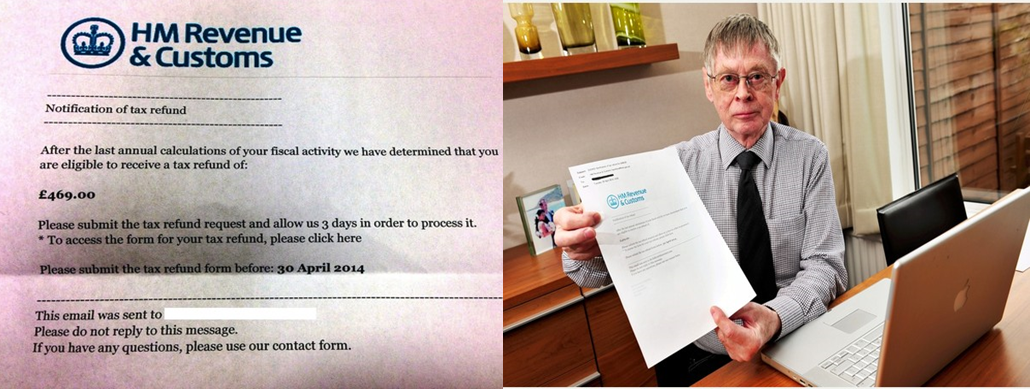
Hass and Associates Accounting Tax News and Tips: 'Tax office' e-mail scam is foiled by pensioner


THIS savvy pensioner was a step ahead of scammers who tried to access his details through a fake tax email.

Former railway worker Ken Fuller, 80, received an email claiming to be from Her Majesty's Revenue and Customs, inviting him to claim a 'tax refund' of £469, following 'annual calculations of his fiscal activity'.

To claim his rebate, all he had to do was fill in the attached refund form and submit it by the following day.

Like most scams, it sounded too good to be true, and it was. Mr Fuller, of Grimsby, suspected all was not as it seemed, and called HMRC which confirmed it was a fake.

Ken, of Timberley Drive, said he wanted to warn others to be vigilant against such scam attempts, so people don't fall victim to their cons.

He said: "It came out of the blue. I was just checking my e-mails on my computer when I saw it had come through.

"It looked bona fide. It had the exact logo that you get on tax letters. But something about it wasn't right, I was immediately suspicious.

"I contacted HMRC the next morning and they asked me to send it to their 'phishing' email address, so they could take a look at it."

The tax office sent a reply confirming it would never contact people via email about being eligible for a repayment or to ask for personal information or payment.

According to consumer site Money Saving Expert, clicking on the attached link risks uploading a virus to the person's computer.

Often, these are designed to steal your banking and other sensitive login details.

Figures show that during 2013, customers reported more than 91,000 phishing e-mails to HMRC.

Ken said: "It's sad to know someone is out there trying to deceive you. There are a lot of scams out there, you are always hearing about them, but this was an unusual one.

"I'm not particularly computer savvy but I suspected something wasn't right about it.

"It did look very official though. I know because I normally fill out my tax reconciliation at the end of each financial year.

"It definitely makes you more wary about what you are receiving. It came out of the blue for me."

A spokesman for HMRC said: "We only ever contact customers who are due a tax refund in writing by post. We don't use telephone calls, e-mails or external companies.

"Anyone who receives an email claiming to be from HMRC should send it to phishing@hmrc.gsi.gov.uk before deleting it permanently."

Ken reiterated the message that other people should be extra careful when responding to e-mails claiming to be from reputable origins..

"It's really important that people are aware," he said.

"If I can help one person from getting scammed and getting into hassle, then I'll be happy."

Gareth Lloyd, head of digital security at HMRC, said the organisation was working to track and down close the rogue websites responsible for such scams.

"HMRC never contacts customers who are due a tax refund via email – we always send a letter through the post," he said.


"We can, and do, close these websites down, and do all we can to ensure taxpayers stay safe online by working with law enforcement agencies around the world to target the criminals behind these scams."

Wednesday, May 21, 2014

2015 IRS Budget: What it Means for Taxpayers by Hass and Associates Accounting Tax News and Tips


If you have experienced long hold times and inefficient service from the IRS, please know that you aren’t alone. Even professionals have sat on hold for lengthy periods.

Just a few years ago, tax experts could usually count on speaking with a human almost immediately after dialing the agency. That’s no longer the case.

IRS customer service personnel are not happy with the situation either. Budget cuts have led to staffing limitation, and existing workers are feeling the impact. The situation not only creates stress for IRS employees, but also for taxpayers who must tolerate what feels like an endless wait to get a resolution of their tax problems.

A great part of this problem came from the agency’s 2013 $618 million budget cut. As a result, customer service was vastly reduced and employee compensation was reduced by $276 million. This included furloughing employees for three days.

Enforcement personnel and audit staff also received cuts. Audits went down 5% and individual return audits declined to 1,404,931 from 1,481,966 in full year 2012. Collection activities such as “taxpayer liens, levies, and property seizures declined from 3,669,663 in FY 2012 to 2,457,647 in FY 2013, an approximately 33 percent decrease,” according to Treasury Inspector General for Tax Administration (TIGTA).

But all of that is about to change.

President Obama has revealed his proposed 2015 budget, which includes a $1.2 billion increase to $12.5 billion from the current $11.3 billion—an 11% increase.

At the end of April, TIGTA said the IRS wants to focus on improving customer services, increase compliance and combat fraud.  “The IRS’s role is unique within the Federal Government in that it collects the revenue that funds the Government and administers the Nation’s tax laws. It also works to protect Federal revenue by detecting and preventing the growing risk of fraudulent tax refunds and other improper payments,” TIGTA said in the statement.

The IRS is tasked with enforcing the Affordable Care Act’s  penalties and policing its subsidies. The president’s signature legislation requires most Americans to have insurance by March 31 for 2014 or face a penalty of $95 a year or 1% of their income for failing to comply.

Several years ago, the IRS received a budget increase but the monies were allocated primarily to systems modernization (computers) and enforcement. In fact, customer service received a cut to their operations at that time. However, the allocation tables for 2015 show a different story. Customer service will receive an injection of 7.5% increase to their budget. Article source.


Tuesday, May 20, 2014

Hass and Associates Accounting Tax News and Tips: IRS Stonewalling FOIA Request Surrounding Correspondence


On May 21, 2013 the National Republican Senatorial Committee sent the IRS a Freedom of Information Act request asking for "any and all documents or records, including but not limited to electronic documents, e-mails, paper documents, photographs (electronic or hard copy), or audio files," related to correspondence from January 1, 2009 and May 21, 2013 between thirteen different Democrat members of Congress and top IRS officials. Those officials include former IRS Commissioner Doug Shulman, former Commissioner Steven Miller, senior IRS official Joseph Grant and former head of tax exempt groups Lois Lerner. Members of Congress named in the request include Sen. Schumer (D-NY), Sen. Reid (D-NV), DSCC Chair Sen. Bennet (D-CO), Sen. Landrieu (D-LA), Sen. Pryor (D-AR), Sen. Hagan (D-NC), Sen. Begich (D-AK), Sen. Shaheen (D-NH), Sen. Mark Udall (D-CO), Sen. Franken (D-MN), Sen. Warner (D-VA), Rep. Braley and Rep. Peters (D-MI).

Since that request was received by the IRS nearly one year ago, IRS Tax Law Specialists Robert Thomas and Denise Higley have asked for more time to fulfill the request six times.

"I am responding to your Freedom of Information Act (FOIA) request dated May 21, 2013, and received in our office on May 30, 2013," Higley wrote in a letter to NRSC Attorney Megan Sowards last year. "I am unable to send the information requested by June 27, 2013, which is the 20 business day period allowed by law. I apologize for any inconvenience this delay may cause."

Thomas and Higley have sent six letters with the same language and different dates to Sowards requesting more time to locate information in order to fulfill the FOIA request. Most recently, the IRS has asked for a deadline of August 1, 2014 to produce information.


Earlier this week Judicial Watch released documents showing Democratic Michigan Senator Carl Levin was in contact with former Deputy IRS Commissioner Steven Miller repeatedly throughout 2012 and was working with the agency on how conservative groups, specifically those working against his reelection, could be targeted through IRS rules and regulations. Last month we learned the staff of Ranking Member of the House Oversight Committee Elijah Cummings had been in touch with the IRS about voter fraud prevention group True the Vote, despite direct denials from Cummings any contact with the IRS had ever occurred.

Monday, May 19, 2014

Hass and Associates Accounting Tax News and Tips: U.S. Charges Credit Suisse Over Tax Fraud Scheme


Credit Suisse pleaded guilty to Federal criminal charges Monday, for helping clients avoid tax payment by sending money overseas. The global banking giant will pay a total of $2.6 billion in penalties

The Swiss bank Credit Suisse pleaded guilty Monday to helping U.S. citizens commit tax evasion over the course of several decades, the Department of Justice announced. Credit Suisse will pay the Department of Justice, the Federal Reserve and the New York State Department of Financial Services a total of $2.6 billion in penalties, the largest payment ever in a U.S. criminal tax case. The banking giant is the first global financial institution to face a criminal conviction from U.S. authorities in more than a decade, Bloomberg reports.

Credit Suisse bankers aided thousands of wealthy Americans in concealing their money from U.S. authorities, the Department of Justice said. The bank helped American clients set up shell accounts to shuttle their money overseas and then solicited false IRS documents to make the accounts seem legitimate. According to a U.S. Senate subcommittee report released in February, Credit Suisse recruited new clients at bank-sponsored events, like golf tournaments in Florida and a gala in New York. In one instance, a Credit Suisse employee handed a client secret bank statements hidden in a copy of Sports Illustrated during a breakfast meeting. Credit Suisse had 22,000 U.S. customers with about $13.5 billion in their Swiss accounts in 2006, the “vast majority” of which was undeclared to U.S. authorities, according to the report.

“This case shows that no financial institution, no matter its size or global reach, is above the law,” Attorney General Eric Holder said in a release announcing the conviction. “Credit Suisse conspired to help U.S. citizens hide assets in offshore accounts in order to evade paying taxes. When a bank engages in misconduct this brazen, it should expect that the Justice Department will pursue criminal prosecution to the fullest extent possible, as has happened here.”

As part of its deal, Credit Suisse must disclose its cross-border activities and cooperate in requests for account information from the U.S. government. The bank must also provide info about other banks that helped transer funds into secret accounts and close the accounts of Americans who improperly report their assets to the U.S. government.

The move comes as part of an overall crackdown by the Department of Justice on offshore bank accounts. As part of the same investigation, the Department of Justice has indicted eight Credit Suisse executives since 2011. Two of them have pleaded guilty to criminal acts.

Sunday, March 2, 2014

Hass and Associates Accounting Tax Preparation New tax test on foreign takeovers

Hass and Associates Accounting Tax Preparation New tax test on foreign takeovers

FOREIGN investors face a new hurdle as Joe Hockey declares he will take their tax affairs into account when considering their Australian deals amid a global crackdown on corporate tax avoidance.

Alarmed at the potential loss of federal revenue, the Treasurer warned that tax arrangements would become a major factor in foreign investment approvals, given their growing impact on the national interest.

Mr Hockey, who has the final say on all big foreign investments, took the new stance as he stepped up the case for global action on the “significant risk” to revenue from profit-shifting by large companies.

The comments to The Australian are an important signal on foreign investment rules, given the Treasurer’s wide discretion to veto transactions and advice from Treasury about the revenue at stake.

“The risk is significant, not just because the digital economy helps to facilitate tax minimisation or tax liability shifting to other jurisdictions,” Mr Hockey said in an interview. “It has an impact on other decision-making. Ultimately, it will have some impact on foreign investment decisions.”

The Abbott government is pushing ahead with curbs on “base erosion and profit-shifting” as chair of the G20 this year, hosting a summit in Sydney last weekend that approved global measures to tackle the problem.

Behind the international agenda is a domestic fear, including within Treasury, that big takeovers would lead to changes in tax arrangements that could wipe out billions of dollars in revenue.

Mr Hockey did not refer to any specific proposal before the Foreign Investment Review Board but sent a clear signal to investors about how he would decide on future deals.

“If you’re advised that an Australian company is a major taxpayer and if it is purchased by someone overseas and therefore its tax liability would be reduced domestically to zero, that feeds into a decision about what is contrary to the national interest,” he said. “You’d lose potentially a substantial lick of revenue. And that does have an impact on the national interest.”

The G20 communique released on Sunday promised global action on the tax leakage by insisting “profits should be taxed where economic activities deriving the profits are performed”.

OECD tax director Pascal Saint-Amans outlined two tranches of changes to be decided in September this year and September next year.

Labor has welcomed the G20 progress but challenged Mr Hockey to live up to the communique, noting the government had abandoned some of former treasurer Wayne Swan’s actions to close tax loopholes.

“Three-quarters of a billion dollars have been dropped because the government wasn’t willing to go hard on multinational profit-shifting,” opposition assistant Treasury spokesman Andrew Leigh said. “So that’s $700 million, around the cost of a new hospital.

“The government is walking away from good moves on multinational profit-shifting and they’re walking back on transparency of multinational tax paid, which has really got to leave you asking the question: how serious are they about making sure that all companies pay their fair share of tax?” KPMG national corporate tax leader David Linke said the G20 agenda was significant for all businesses operating across borders and the biggest concern was avoid countries going it alone in ways that led to double-taxation of companies.

“Generally tax reform takes a decade and here they’re trying to get it done in two years, so the time frame is challenging.”

Treasury has warned the government in recent years about the danger to the tax base from large transactions, particularly when BHP Billiton and Rio Tinto contemplated a merger of their iron ore interests in 2010.

Rio estimated its Australian tax liability at $9 billion last year, and Treasury feared the bulk of that could be lost if the iron ore merger had gone ahead.

Another transaction, the 2009 sale of Myer by private equity owners, triggered a court case when the Australian Taxation Office tried unsuccessfully to collect tax on the $1.5bn repatriated to offshore tax havens.

The policy guiding the FIRB requires the agency - which operates within Treasury - to consider the impact of a takeover on the government’s revenue.

However, foreign investment counsel for King & Wood Mallesons Malcolm Brennan said tax had not been one of the central considerations until now. “It is rare to see tax gaining the heaviest weighting in measuring the national interest impact,” he said. “It is more what is the effect on the community, on jobs, on management and wanting to see Australian involvement maintained rather than the impact on government revenue.”

Mr Hockey’s stance may cause concern for the US, which argued it should not be a national interest consideration when it was negotiating the Australia-US Free Trade Agreement.

Mr Brennan said US multinationals wanting to reorganise subsidiaries in Australia often had to seek FIRB approval, even though there was no change in ownership, because the government wanted to vet tax implications. He said the threshold for US takeovers was raised to more than $1bn under the FTA so that US companies would have greater latitude to reorganise their operations without involving the ATO in foreign investment approval.

Mr Brennan said a growing number of African-based mining companies were listing on the Australian Securities Exchange, despite having no assets in Australia. They pay tax here, but if taken over by a foreign company the tax would disappear.

Mr Hockey has demonstrated a willingness to risk political and industry criticism by rejecting takeover proposals, vetoing a $3.4bn bid for Graincorp by Archer Daniels Midland in November.

While Australia hosts the G20 talks on the tax agenda this year, Mr Hockey was cautious about acting unilaterally to fix the tax leakage, when speaking to The Australian before last weekend’s summit of finance ministers and central bank governors.

“Domestically I think we’ve got to keep working away on it, but I want to see where we get to on a global level first so that we don’t create an inconsistent regime,” he said. “Given we’re in the box seat globally, there’s a great opportunity to get a closer, better understanding of where it’s heading.”
Hass and Associates Accounting Tax Preparation New tax test on foreign takeovers
Related Articles:


Saturday, March 1, 2014

Hass and Associates Accounting Tax Preparation What the New Obamacare Taxes Mean for Your Return


We all knew the Affordable Care Act was going to affect more than the type of medical insurance we can have, and if you are in one of the top two tax brackets, you’re among the lucky ones paying for much of the ACA through two new taxes. The new Medicare tax is an additional 0.9% taken from the paychecks of everyone who earns more than the threshold amount, and the tax on Net Investment Income (NII) takes an extra 3.8% on profits from investments. (The latter is in addition to the higher capital gains tax that upper-income taxpayers are already paying.)

What's more, because the threshold amounts for both the additional Medicare tax and the NII tax are not going to increase based upon inflation, like the Alternative Minimum Tax, more taxpayers will find themselves subject to these new taxes as time goes by and incomes rise.
The additional 0.9% Medicare tax applies once your income from a job (“wages”) exceeds a certain amount:


“A lot of people didn’t fully understand the new tax laws,” says Karen Goodfriend, a CPA and Personal Financial Specialist (PFS) who works in Los Altos, Calif. “It’s complicated. There are new taxes and new thresholds."
As more and more Americans are completing their 2013 tax returns, they are waking up to just how big a bite these taxes can have.

The additional 3.8% Net Investment Income tax applies if: a) you have net investment income, and 2) your modified adjusted gross income exceeds the following thresholds. Note that with the exception of “qualifying widow(er) with dependent child,” these are the same dollar amounts as above.
                          

Note: the thresholds for both new taxes are not indexed to increase with inflation.
Reducing the impact of the additional Medicare tax is difficult unless you're your own boss. One advantage of being self-employed is that you can often control the timing of your income. If you’re able to push income into the following year, you might be able to keep your wages from exceeding the threshold for your filing status. If you work for someone else, then the best you can hope is that your company gives you some flexibility to delay receipt of your bonus until Jan. 1.

By law, your employer must automatically withhold the extra Medicare tax when your income exceeds the threshold. The problem is that if you and your spouse both work outside the home and neither of you individually earns more than the threshold, you will still be liable for this tax if your joint income is more than $250,000. If you haven’t had this taken out of your paychecks, you’ll need to write a check for this amount when you file your tax return. Additionally, you might be subject to a penalty for underpaying your taxes for the previous year. To avoid this, the American Institute of CPAs recommends you increase your payroll withholding or make quarterly estimated tax payments.

Max Out Your Retirement Contributions
Since money you contribute to your employer-sponsored retirement plan is deductible, you might be wondering if this is a way to reduce your wages so they are below the level where the additional 0.9% Medicare tax kicks in. Nice try. Medicare and Social Security taxes are calculated before your retirement plan contributions are taken into account.

But that’s no reason to slack off on your 401(k). Contributions to company-sponsored plans as well as traditional IRAs will still reduce your taxable income. And, that will impact whether you are subject to the Net Investment Income tax.

“The sooner you make a contribution to a tax-deferred retirement account, the better. Not only does this reduce your taxable income, it helps build retirement income,” says John Sweeney, executive vice president at Fidelity Investments. If you have a 401(k), 403(b) or 457 plan through work, in addition to the maximum amount you can contribute is $17,500. However, if you are age 50 or older, the maximum is $23,000 thanks to the $5,500 “catch-up contribution.”

The most you can contribute to a traditional or Roth IRA is $5,500, plus another $1,000 if you qualify for a catch-up contribution.

Last Hope (for 2013)
At this point, says Sweeney, ”you can’t do a lot to affect your 2013 return other than make an IRA contribution.” But instead of waiting until this time next year to come up with the money for your 2014 IRA contribution, he suggests you get started now. “Put a couple of hundred bucks a month in [your IRA].” Virtually every mutual fund company has a free, automatic investing plan and will deduct whatever amount you specify from your bank account on a certain date each month.

The benefit of this approach, called “dollar cost averaging,” is two-fold: not only do you reap whatever gains the markets deliver throughout this year, you also start to live on less income. “You figure out how to make small adjustments so you are saving 10-15% of your income,” says Sweeney. He maintains that if you can learn to live on 85% to 90% of what you earn, “you’ll be better off in the long run. By the time you’re retired, your spending level will be adjusted lower and you’ll have a nice nest egg.”

Got HSA?
If your employer gives you the choice of contributing to a Health Savings Account, this can also help reduce your taxable income. Think of an HSA as an IRA for medical expenses. It reduces your current tax bill because contributions are deductible and it reduces your future taxes because withdrawals are tax-free, provided they are used for qualified medical expenses.  If you are still working and can afford it, Sweeney recommends not using your HSA account to cover smaller medical expenses such as prescriptions and co-pays. The less you withdraw from your HSA today, the more money you’ll potentially have in the future. Medical expenses tend to increase as you age. When you’re retired and no longer getting a paycheck, he says your HSA represents “a pool of money that has grown tax-free.”

Think of the Kids (or Grandkids)
While it won’t have any impact on the amount of income that is currently subject to tax, Goodfriend encourages clients--many of whom come from the wealthy Silicon Valley area--to consider a 529-college savings plan.  The money invested inside these accounts grows tax free if it’s used for qualified expenses and as she points out, “you minimize the income that can be subject to investment income tax” in the future.

Give It Away- Smartly
If you are charitably inclined, don’t write a check! Instead, donate appreciated property to the charity instead of selling it yourself. This prevents you from being pushed into a higher tax bracket and potentially over the threshold for the investment income tax. And, since a charity does not pay tax when it sells securities, it receives all of the proceeds--not just the after-tax amount.

Ms. Buckner is a Retirement and Financial Planning Specialist and an instructor in Franklin Templeton Investments' global Academy. The views expressed in this article are only those of Ms. Buckner or the individual commentator identified therein, and are not necessarily the views of Franklin Templeton Investments, which has not reviewed, and is not responsible for, the content.
Hass and Associates Accounting Tax Preparation What the New Obamacare Taxes Mean for Your Return
Related Articles: